One Model to Rule them All: Towards Zero-Shot Learning for Databases
- Authors: Benjamin Hilprecht, Carsten Binnig
- Institute: Technical University of Darmstadt, Germany
- Published at CIDR'22
- Paper Link: http://cidrdb.org/cidr2022/papers/p16-hilprecht.pdf
Background
There have been many new proposals for using AI to improve DBMS components such as:
- More accurate cost estimators
- Faster query optimizers
- DBMS auto configurations (parameter tuning and physical design)
Motivation
Those learning-based techniques usually require retraining once we apply them to a new database or workload, which may require great effort to collect training data.
Problem
This paper aims to propose several techniques that help learning-based methods perform well when they are transferred to a new database without retraining.
Method
Key Insights
There are a few insights that may be the keys toward zero-shot learning techniques:
- Transferable representations of database and queries
- In order to make a learning-based technique transferrable across databases, the format of representations should not depend on databases and queries.
- Training data collection and robustness
- How to collect effective training data is important to enable zero-shot learning
- A preliminary experiment shows that we can use a relative small training data set to outperform the state of the art when transferring from one database to another.
- We need a way to guide us to find more effective training samples
- Separation of concerns
- Decomposing a end-to-end model into smaller task-specific models help these small models more transferable across databases.
Transferable Representations
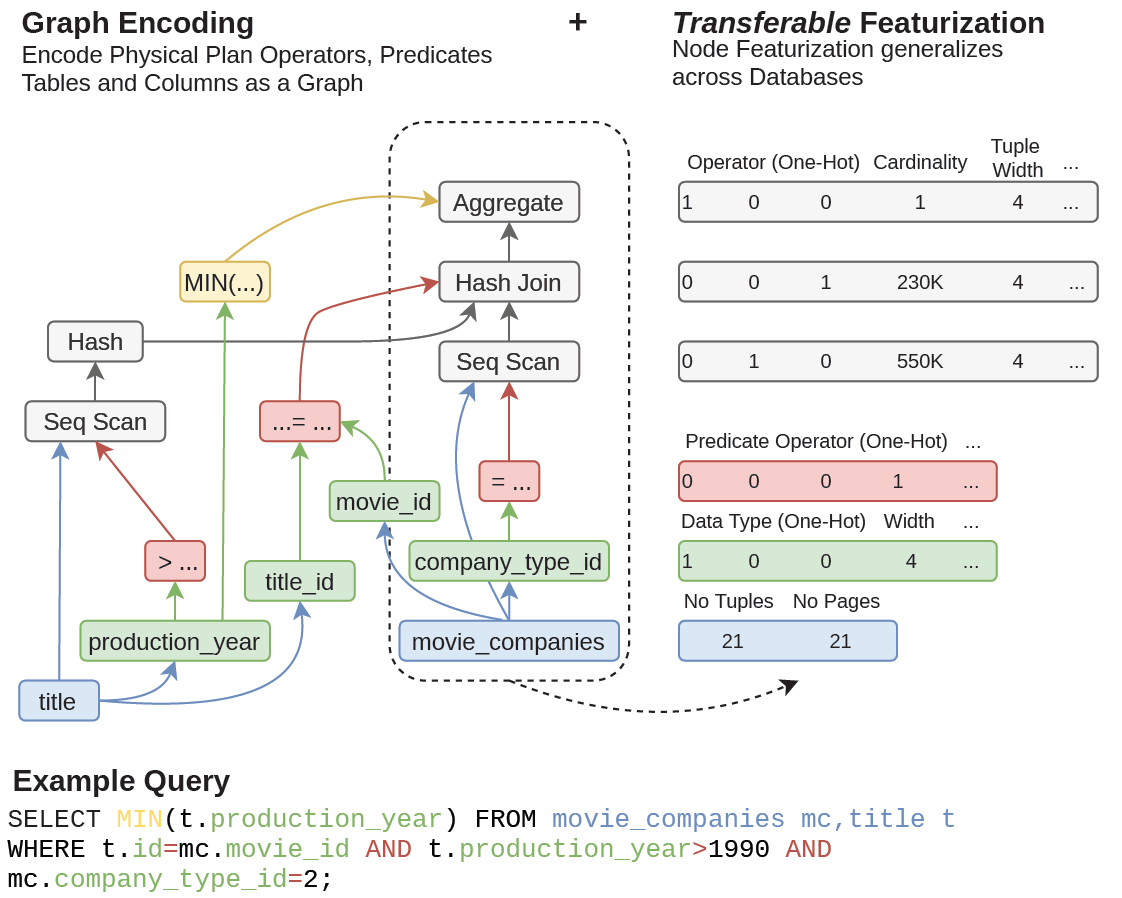
Two key techniques:
- Graph Encoding
- Modeling plan operator, predicates, table names as graph nodes
- Transferable Featurization
- Using general statistics instead of database-specific features, such as number of tuples and pages.
Experiments
The initial results show that their models outperforms the state of the art models on an unseen database (IMDB) without additional retraining.
Conclusion
- Interesting direction
- Needs more descriptions on how to feature queries and other case studies