P-Store: An Elastic Database System with Predictive Provisioning
- Authors: Rebecca Taft, Nosayba El-Sayed, Marco Serafini, Yu Lu, Ashraf Aboulnaga, Michael Stonebraker, Ricardo Mayerhofer, Francisco Andrade
- Institute: MIT, Qatar Computing Research Institute - HBKU, Urbana-Champaign, B2W Digital
- Published at SIGMOD'18
- Paper Link: https://dl.acm.org/doi/abs/10.1145/3183713.3190650
Motivation
DBMS machine provisioning is an important topic that controls the elasiticity and resource utilization of a distributed DBMS.
However, existing approaches always react slower than the actual demand.
Problem
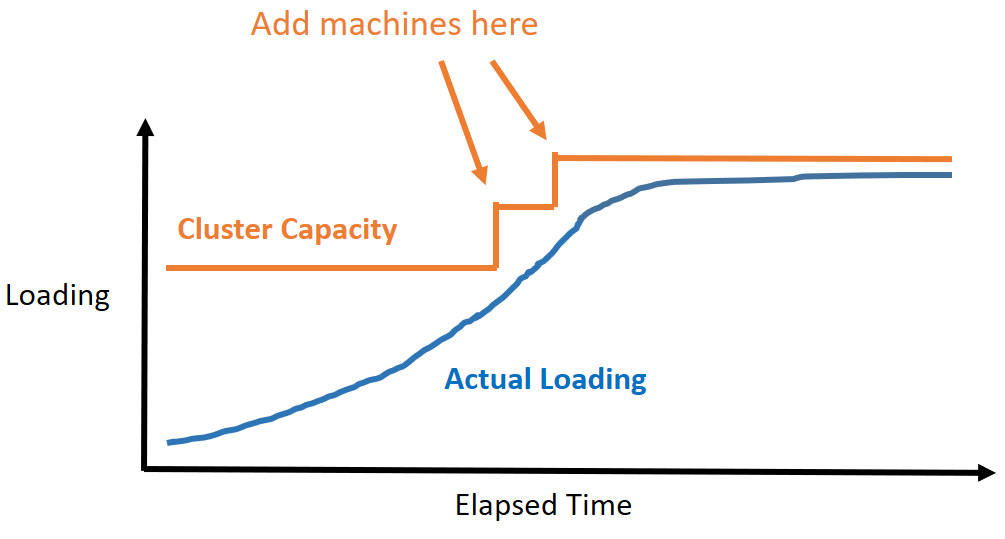
To design a system online reconfiguration strategy that reacts before the system overloaded such that:
- the resource used by the system is minimized
- the reconfiguration does not violate SLA.
Input:
- A prediction to the future workload
- The capacity of a machine
Output:
- When to add/remove machines
- How many machines to be added or removed
Assumptions:
- The target workload has periodic patterns that are easy to be predicted.
- There is no spike in the workload.
- Only a few distributed transactions.
This goal can be visualized as follows:
Method
Two Parts:
- Workload Prediction
- Allocation Decision
Workload Prediction
Models the workload as a time series data and uses Sparse Periodic Auto Regression to predict [USENIX'08].
Models the future workload at a time as a sum of a long-term pattern (past n days) and a short-term pattern (past m minutes).
Allocation Decision
Use DP.
Comments
- Pros
- Works well on predictable workloads
- Cons
- The workload must be easy to predict
- The database must be easy to partition so that P-Store won't need to consider the impact of distributed transactions.